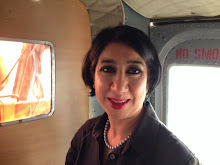
Lady Olga Maitland, President of the Defence and Security Forum, hosted a wonderful Black Tie literary dinner last night- with a sumptuous three-course meal and candles to a packed room - for what was the very first official outing of my biography of Sonia Gandhi published by Palgrave Macmillan in America on September 13, 2011.
I was in distinguished company because Lady Olga knows everyone- from British cabinet members and prime ministers to foreign heads of state. Previous speakers at the Defence and Security Forum include Sandy Berger, Adviser to President Clinton, HRH Prince Michael of Kent,and author Frederick Forsyth.
She had read a proof copy prior to last night as the book has only just been published and finished copies are only now available. She was so complimentary and enthusiastic I was quite overwhelmed. Lady Olga had placed a wonderful collection of people on our table,and after my 23-minute talk some great, piercing questions were asked- all under Chatham House rules. While her aristocratic ancestors smiled down at us from their large gold -framed portraits on the walls, the conversation flowed and there was clearly a lot of interest.
It is wonderful to see the first responses to the book after a year and a half of hard labour on this challenging project.
The upcoming speakers for the Defence and Security Forum include His Excellency Sir Mark Lyall Grant, KCM UK, who is the British Permanent Representative to the U.N., and General Sir David Richards, GCB, CBE, DSO, British Chief of Defence Staff.
Wednesday, 21 September 2011


Wednesday, 14 September 2011
British armour steel deal inked with Tata Steel and Ministry of Defence
The MoD announcement today read, "UK INVENTION BRINGS SOVEREIGN CAPABILITY FOR ARMOURED STEEL"
The UK now has its own onshore supply of high-performance armour steel, thanks to a UK invention and a new manufacturing agreement.
Known as super bainite, the new armour steel has been developed to have outstanding ballistics properties and, in tests, it has performed better than ‘normal’ steel armour.
The Ministry of Defence has signed a licensing agreement with Tata Steel to manufacture the steel in the UK.
Showcased at Defence and Security Equipment International (DSEi) today, the material was invented and developed in the UK, with production ear-marked to take place in Port Talbot, South Wales. Under the agreement the steel will be turned into seven different items, including perforated armour plates that could be used on future frontline armoured vehicles.
Visiting the UK Capability Showcase at DSEi, Minister for Defence, Equipment Support and Technology, Peter Luff, said:
“This cutting-edge UK invention and the manufacturing agreement mean that the UK now has its own onshore supply of high-performance armour steel. Super bainite has both military and civilian applications providing Tata Steel with important export opportunities.
”The application of new, battle-winning technologies is what gives our troops the edge. This demonstrates, once again, that investing in research and development, in partnership with industry, means that our troops can have the latest innovations in frontline equipment.”
Super bainite was invented by Defence Science and Technology Laboratory’s (Dstl) Professor Peter Brown, Professor Harry Bhadeshia, Tata Steel Professor of Metallurgy at Cambridge University and Dr Carlos Garcia-Mateo, previously at Cambridge University and currently at the National Centre for Metallurgical Research, Madrid.
The outstanding protection properties of super bainite are down to unique production processes. Traditionally, steel is covered with water to get it to room temperature quickly before structural weaknesses can form. But with super bainite, a whole variety of cooling methods, using air or even molten salt, are used throughout production. Combining drilling and hole-punching during the cooling process results in ultra high-hardness perforated plate.
Dstl’s Professor Brown said:
“The ballistic performance of perforated super bainite steel armour is at least twice that of conventional rolled homogenous steel armour. This is because the introduction of perforations creates a large number of edges which disrupt the path of incoming projectiles, significantly reducing their potency.”
Dstl owns the patents relating to the chemical composition and processing of super bainite. The licence agreement was signed between Ploughshare Innovations and Tata Steel. It allows Tata Steel to manufacture and process super bainite in the UK and in Europe and to export it globally.
Dr. Paul Davies of Tata Steel hoped defence equipment manufacturers, especially armour systems specialists, will recognise the steel’s potential for appliqué up-armouring applications. He said:
“Tata Steel has spent significant effort developing this unique product and we are delighted with its performance. We have outlined our market strategy. Tata Steel is well positioned to support the market, both in the UK and across the remainder of European markets by exercising existing infrastructure to produce and process the material for future customers.”
Monday, 12 September 2011
British Foreign Secretary talks about Britain's new diplomatic thrust
Thursday September 8, Foreign Secretary William Hague outlined Britain's new foreign policy outlook in a speech at the Foreign and Commonwealth Office, London. I have picked out the most interesting points from his talk; strikingly, the admission of Britain's waning influence across the world.
"We are significantly increasing our diplomatic presence in India and China, the world’s two emerging superpowers by increasing the number of frontline staff in each country by 30 and 50 positions respectively, and focussing on their fastest growing cities and regions in each country, some of which have GDPs larger than whole European countries.
We are substantially expanding our diplomatic strength in Brazil, Turkey, Mexico and Indonesia, Burma, Thailand, South Korea, North Korea, Mongolia, Malaysia, Nigeria, Angola, Botswana, Chile, Argentina, Colombia, Panama, Peru, Pakistan, Vietnam, the Philippines and our presence in Taiwan, maintaining the strength of our delegations to the United Nations in New York and Geneva, NATO and the European Union and keeping our network of Consulates General across the United States.
We have made a firm pledge that this Government will not close any of the existing 140 UK Sovereign Posts overseas - which means Embassies or High Commissions - during the lifetime of this Parliament; and we will open six new Embassies and up to seven new Consulates General in the emerging economies, including one in Recife in Brazil.
Our new Embassies are in South Sudan, where we opened our new Embassy the day that new state came into being;
In Kyrgyzstan, where our new Embassy will open later this year;
In Côte D’Ivoire, where I announced this week that we will re-open the Embassy that was closed in 2005;
In El Salvador and Madagascar where we are also reopening posts closed by the previous government;
And in due course, we hope to open a new Embassy in Somalia. It is not possible now because of the security situation, but we will be ready as soon as we judge that circumstances permit, and in the meantime we will set up an Embassy for Somalia in Nairobi.
This effort is aimed at preventing what I call the strategic shrinkage of Britain’s influence in the world.
In the countries where Embassies had closed that we are now re-opening, we are sending a signal that Britain is back in the business of serious diplomacy with them. Where we are increasing the numbers of FCO staff and consulates, we are able to build deeper diplomatic relationships and do more for British business and British citizens."
Sunday, 21 August 2011
The first time ever on British television; the Life of The Prophet
Three one hour television documentaries for a series called “The Life of Muhammad” were on BBC Two recently. It was the first time that British television had shown a biography on the Prophet, whose message forms the religious base for one and half billion people round the world.
Filmed on location in Saudi Arabia, Jerusalem, Turkey, the USA, the UK and Jordan, all the drama, tragedy and triumph of the epic narrative of the life and teachings of one of the most important religious figures of all time was laid out for the viewer. One of the biggest names on the subject was part of the production team; author, scholar and broadcaster Ziauddin Sardar wrote the whole series.
The documentaries traveled to the place of the Prophet’s birth, and re-traced his actual footsteps from his early years in Mecca, his struggles with accepting his Prophetic role, his flight to Medina, the founding of the first Islamic constitution, his successes and failures, militarily and politically, through to his death and his legacy.
Mr Sardar, who agreed to be interviewed by email, said that non-Muslims could “learn a lot …and get a thrilling story as a bonus” –while Muslim viewers might discover things from the series that they did not know before. He said, “We based the film on classical biographies –particularly Ibn Ishaq’s Life of the Prophet, regarded by all Muslims as the first and most authentic biography.” The program makers interviewed with, among others, John L. Esposito, professor of religion, international affairs and Islamic Studies at Georgetown University, H.R.H. Princess Badiya El Hassan of the Jordanian Royal family, author Karen Armstrong and Sajjad Rizvi, associate professor of Islamic intellectual history, Exeter university.
Mr Sardar explained that he wanted to show that the details of the life of the Prophet are alive and vivid for Muslims today, so image sometimes contrasted with narrative. “We often used contemporary scenes and related them back to the time of the Prophet.”
The first episode, which got 1.8million viewers, was acclaimed for its sensitivity and intelligence in dealing with the visual challenge of finding ways of talking about the Prophet without depicting him. (Depictions of the Prophet are not allowed in Islam).
“Another challenge was to get the balance right, and ensure that the diversity of Islam, and all the different views – from the orthodox to the liberal, Sunni, Shia, Sufi, as well as western critics, and the voices of women –are all represented…we had a Shia consultant, an established scholar in the field, who advised us and made sure we took his views into account. Yet another challenge was to explore how Muslims today use the Prophet as a model, how close or [how]far they are to the spirit of his life. It was like walking a tightrope”
In keeping with Mr Sardar’s back catalogue of books and television programs, authenticity and respect were hallmarks of the series. “We took particular care to be respectful to the Prophet. As Muslims we could not do otherwise.”
Mr Sardar wrote all of the presenter’s links, including the introduction, in which the narrator said “Peace be upon him” after the name of the Prophet. It set the tone of the films.
“But we also had to deal with the controversial aspects of his life fairly and objectively. So we took particular care both to be deeply respectful and honest in our treatment of difficult subjects.” Using excellent sources and referring to them constantly gave the series an authoritative platform.
The writer’s role in this series cannot be overstated, for it is through the words and stunning images that programs about the past can work best. “The Life of Muhammad” is the first biographical documentary that not only features no visual images of its subject; it also has no dramatic reconstructions of the subject’s life. Strong landscapes, art and architecture accompanied by atmospheric music work well with the powerful narrative and set a benchmark which led one Guardian reviewer to write; “Visually at least, many television directors should consider converting to Islam.”
Saturday, 20 August 2011
Rani's physical health - I love my gym!
I've been a gym member for over a decade and in 2010 when I wanted to find a new one I did a thorough survey of all the good gyms in West London. Some of the prices were astronomical.
The one I settled on is part of a set owned by Charlie Bourne, called "Eden Fitness" in Ealing.
The main reason I joined was because this gym offers a class I haven't found anywhere else; Total Cardio, which is 45 mins of interval training on three separate machines- the treadmill, the crosstrainer, and the cycle. Sometimes we play the Fish Game on the rower. It is such a simple concept and so many gyms have dedicated cardio sections I am really surprised not to find it anywhere else.
The second thing about Eden is the amazingly high level of hygiene- the facilities and cloakrooms are always clean and the pool area has a special "saunarium" -ideal for relaxing.
But I think what is really adding to the quality of my life is the standard of the staff. Reception people are chatty and friendly.
I adore all my instructors in the cardio teaching team; Carlos Newton,Paul Stribling, Matt Fox, Steve Perkins, Roz Gerber, Darren Carroll and Gavin Mehta. It has taken me quite a long time to appreciate how prodigiously talented my instructors are as they don't do any hard selling on special trainer sessions -I just found out they are good by talking with them and having classes with them. Each of them has a different technique -so the blend of working out with them all over a fortnight is a perfect, heady cocktail. They all keep an eye on me when I am on the gym floor -proactively checking
my posture etc as opposed to some instructors in other West London gyms who practically ignore members.
Gavin has been introducing me to kickboxing over the last few weeks and since he is a martial arts specialist I am hoping to get some self defence training from him further down the line. After returning from India last year and seeing how the Special Protection Group, in common with other international military units, study Krav Maga, I approached Gavin. He has devised his own form of self defence suitable for someone like me- using techniques from many established styles, including Krav Maga.
Lastly, I love my yoga teacher -Shanti Gill -who teaches a special class of Chiyoga- a blend of Tai Chi and yoga- as well as the more intense forms the rest of the week. If I concentrate, I can feel my mind going into a meditative state during Chiyoga.
During the English riots last week, Charlie Bourne, his wife and around eight others spent the night on the couches of the reception area to protect the premises in case of attack so we didn't lose access to the gym though the hours were shortened on the worst days.
I lost some fitness toward the end of 2010 and during the first six months of this year while I was writing intensively so I will need to work hard over the next few weeks to return to form.
Eating right will be my biggest challenge!
Saturday, 13 August 2011
India's Finance Minister Pranab Mukherjee meets UK Minister George Osborne
Last month journalists had quite a day with the Indian finance minister and his delegation to the UK.
On the 25th of July 2011, there was a morning press conference in the Foreign and Commonwealth Office with the two gentleman, their heights in inverse proportion to their numbers of years in government, when they expressed deep satisfaction with trade relations between their two countries.
They proudly stated that India is now the third largest investor in the UK, and the UK is the fourth largest investor in India.
They announced that billions of dollars' worth of trade deals had been signed, and pointed to a recent BP/Reliance deal which represented the single largest foreign investment ever in India.
They both sidestepped my question to them about which country had greater need for the other, replying that each had a healthy respect and need for the other, refusing to be drawn on the precise balance of power.
The press conference finished before 12.0pm. Some of the Indian journalists were going to wait around for another briefing with Mukherjee at India House, the Indian High Commission, at 5.0pm that day. One of them said, "It's going to be a very long lunch."
Sunday, 31 July 2011
A little bit of Thailand in West London
Walking home from my yoga class taught by Shanti this morning, I was distracted by the sound of Thai music and the sight of different nationalities queueing up in an orderly fashion to buy tickets for the Thai festival on Ealing Common. Huge security guards in shades and dark blue T - shirts contrasted with the diminutive orientals by the entrance to this event, now in its second year, organized by Nikie Chumai.
Mr Chumai is a restaurant owner who spends nine months of the year in Thailand, three in the UK, and aims to develop closer cultural ties between the two countries; one of his plans is to organize a British event in Thailand with the help of the British embassy in Bangkok.
The festival covered two days, and was opened by a member of the Thai royal family accompanied by the Thai ambassador to the UK.
Large carved statues of Buddha reclining or sitting smiling benignly inside the barriers appeared alongside intricately carved vegetables and pastel colored soap bars. There was delicious food and drink served by Thai restaurant owners who were making sure that everyone paid -cash, and no freebies.
At a small stage, exquisite dancers and musicians performed for an interested public relaxing on the grass in the sunshine. The festival can be compared with the mega Asian melas running up and down the UK over the Summer- this one is much more sedate, with between 3-6,000 visitors each day.
The Thai population in the UK is estimated at 30,000.
Subscribe to:
Posts (Atom)