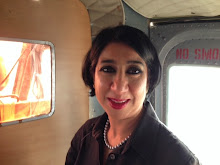
Heading into the Congress Party Headquarters, there is a room set up for a media conference with Congress spokesman Abhishek Singhvi.
The first surprise is that we get given Indian sweets and savouries and a plastic cup of piping hot tea. When did that ever happen at the G20 or anywhere else for that matter?
Abhishek moved seamlessly between perfect high Hindi and perfect high English with plenty of humour thrown in. Once he'd given his statement, the questions came thick and fast, shouted not spoken, and when I tried to stand up and present my question in the quaint old-fashioned way we are taught to behave in the West, he told me not to bother to stand!
I look forward to some more of these. Usually I am out in India or Pakistan on single story assignments and don't have time to be part of the press pack, so I am interested in life as an Indian hack...for a short while.
Friday, 12 February 2010


Sunday, 31 January 2010
Farrukh Dhondy's Latest Short Story, for the Times of India's Crest Magazine 30/1/2010

Click anywhere on text to enlarge
Thursday, 28 January 2010
London Afghanistan Conference Communique
This site below carries the full text of the Communiqué from today's Afghanistan Conference.
http://afghanistan.hmg.gov.uk/en/conference/communique/.
http://afghanistan.hmg.gov.uk/en/conference/communique/.
Sunday, 24 January 2010
TV Commentary on US Defence Secretary Robert Gates in India
With US Defence Secretary Robert Gates's visit to India this week, ahead of his meetings in Pakistan, I was asked by Al Jazeera English to comment on India's relations with the US, China and the Russian Federation. I was able to mention the remark made to me by the Private Secretary to the Indian PM, "President Obama speaks to the Prime Minister very frequently."
Of course, while relations are warming with the US, India doesn't forget her old ally the RF, with whom she has a ten-year military pact and from whom she has just bought a number of MIG 29 fighter jets.
India says she plans to spend $50b over the next five years on updating her military hardware. Boeing and Lockheed Martin have both been licking their lips over a $10b contract for 126 multipurpose fighter jets, on the cards since 2008. The smart money is on Boeing getting the deal.
The Indo-US 2008 Singh-Bush civil nuclear deal helps India reconcile her ambitions with her limited uranium reserves.She wants to quintuple her nuclear-energy generated electricty output by 2020.
Of course, while relations are warming with the US, India doesn't forget her old ally the RF, with whom she has a ten-year military pact and from whom she has just bought a number of MIG 29 fighter jets.
India says she plans to spend $50b over the next five years on updating her military hardware. Boeing and Lockheed Martin have both been licking their lips over a $10b contract for 126 multipurpose fighter jets, on the cards since 2008. The smart money is on Boeing getting the deal.
The Indo-US 2008 Singh-Bush civil nuclear deal helps India reconcile her ambitions with her limited uranium reserves.She wants to quintuple her nuclear-energy generated electricty output by 2020.
Wednesday, 20 January 2010
UK Still Spending on Counter-Terrorism in Pakistan
Just received this note from the Foreign Office;
"Year on year, counter-terrorism spending has increased this CSR. On current plans we expect a further increase next year. Spending on counter-terrorism this CSR is more than double what it was in the last CSR.
Pakistan has remained our top priority for counter-terrorism and has rightly been the largest single recipient of our counter-terrorism support throughout this period.
We are constantly reviewing the precise allocation of our counter-terrorism spending to ensure that programmes are most likely to reduce the threat of terrorism and radicalisation.
Looking more broadly than counter-terrorism, the UK is the second largest aid donor to Pakistan and we are increasing our aid for the period 2009-13 to £665 million "
"Year on year, counter-terrorism spending has increased this CSR. On current plans we expect a further increase next year. Spending on counter-terrorism this CSR is more than double what it was in the last CSR.
Pakistan has remained our top priority for counter-terrorism and has rightly been the largest single recipient of our counter-terrorism support throughout this period.
We are constantly reviewing the precise allocation of our counter-terrorism spending to ensure that programmes are most likely to reduce the threat of terrorism and radicalisation.
Looking more broadly than counter-terrorism, the UK is the second largest aid donor to Pakistan and we are increasing our aid for the period 2009-13 to £665 million "
Monday, 18 January 2010
Cold War Allies Still; India Buys Russian Fighter Jets
From the Economic Times;
NEW DELHI: Russia will supply more than two dozen MiG-29 fighter jets to India's navy in a $1.2 billion deal to be finalised this week, a defence
ministry official said on Monday.
The proposed deal comes after the two countries agreed on a 10-year military pact in December to cover weapons development, aircraft and maintenance contracts worth more than $5 billion.
The agreement was signed during a trip to Russia by Indian Prime Minister Manmohan Singh, reflecting the former Cold War allies' desire to maintain a close defence relationship.
NEW DELHI: Russia will supply more than two dozen MiG-29 fighter jets to India's navy in a $1.2 billion deal to be finalised this week, a defence
ministry official said on Monday.
The proposed deal comes after the two countries agreed on a 10-year military pact in December to cover weapons development, aircraft and maintenance contracts worth more than $5 billion.
The agreement was signed during a trip to Russia by Indian Prime Minister Manmohan Singh, reflecting the former Cold War allies' desire to maintain a close defence relationship.
Article by PM Gordon Brown
British PM Gordon Brown has just written this article, which was published in the UK, on Millennium Development Goals;
"The unpredictable crises like the catastrophe in Haiti show once again both the fragility of life on our planet, but also the very human instinct to come to the assistance of those in need. The impact of the earthquake has been truly horrific for Haiti's people and it is a catastrophe that is still unraveling. It is a tragedy beyond imagination.
Where men and women and children are suffering under the heaviest of burdens that place must for that moment become the centre of our world's attention, the world's compassion and the world's humanitarian help.
But we should not lose sight of our wider responsibilities to address the daily suffering of millions. The first decade of this millennium was striking for the way concern over global poverty finally captured headlines and attracted sustained political and popular attention.
In the years immediately after the breakthrough agreement on Millennium Development Goals, great strides were made and there were genuine grounds for optimism. Now a convergence of global crises - which are economic and environmental - threatens to reverse recent gains and end an era of progress when it has only just begun.
For poor countries, the climate crisis is not some abstract problem measured in terms of future generations but a stark, dangerous and pressing reality. Ecological catastrophe is already killing 1,000 people every day and a new hunger emergency looms.
While the climate crisis has been slow to build, the effects of the financial storm have been sudden and severe. Without diminishing the suffering the global recession has caused many families in the well-off world, there should be no doubt that in poorer countries it has been the grim difference between life and death.
Let me put the toll plainly. It is feared that 400,000 more children will die each and every year and millions more who would otherwise be on the path to learning will grow up unable to read and write.
So faced with two grievous and simultaneous challenges, I believe that the 12 months of 2010 will be as decisive as the 10 years of the last decade. Our mission must be both to deliver past pledges and pursue new ways to answer climate change and overcome the economic constraints that could imprison hundreds of millions in permanent poverty and despair.
First, we must stay the course to make poverty history. Britain will not only keep our aid promises in 2010, we will exceed them. That is why today, the UK is publishing draft legislation that would make it the first country in the world to give a permanent guarantee we will reach and maintain the United Nations aid target of 0.7 per cent. Of course, aid alone is not the whole solution. But with revenues falling and demand for services increasing in developing countries, aid can play an irreplaceable role in keeping schools and hospitals open and providing a vital safety net for the destitute.
The terrible events in Haiti also remind us of the need not just for development assistance but humanitarian relief to save lives in emergencies. The UK has already sent specialist teams and pledged £6m to help kick-start the aid effort - we know that much more will be needed as we move from relief to recovery.
Second, given the scale of the challenges, we must find new and innovative sources of finance to fight poverty and climate change. We have already generated billions of pounds by selling bonds and from public donations, but I am convinced that more is practical as well as possible.
The IMF, for example, is looking at how the financial sector can contribute more towards paying for the burdens of government intervention, including a global financial transactions tax which could raise substantial revenues if the details can be addressed.
Third, we must ensure that developing countries not only deal with the crises but invest in the future. As in the UK, investing in education is critical to future growth. That's why I'll be working with Sepp Blatter from Fifa and President Zuma of South Africa who have vowed to make education for all the legacy of the first World Cup in Africa through the 1-Goal campaign.
Fourth, we must encourage the capacity of developing countries to grow their own way out of poverty. There is, through the G20, a new opportunity to pursue global growth that includes and benefits low-income economies.
This year, we have all the international means that we could wish for to embed progress and account for the pledges we undertook at Gleneagles at the climax of the Make Poverty History campaign. Most crucial is the UN Poverty Summit in September, where I believe we must agree a substantive global action plan - underpinned by specific national commitments - that sets out clearly how we will achieve the Millennium Development Goals.
To build momentum, we must build high level political resolve early. 2010 is a test of the world's concern for the poorest - and their faith in us. In conscience and in our own self-interest, for their sake and ours, we dare not fail. We must act now to give the entire world back its future and its hope."
Amids all the politicking and pre-election grandstanding, in an environment where parties are keen to take potshots at each other, certain qualities and redeeming features may be overlooked. It isn't often noted that Gordon Brown is passionate about education, and gave a very acceptable TED talk recently.
"The unpredictable crises like the catastrophe in Haiti show once again both the fragility of life on our planet, but also the very human instinct to come to the assistance of those in need. The impact of the earthquake has been truly horrific for Haiti's people and it is a catastrophe that is still unraveling. It is a tragedy beyond imagination.
Where men and women and children are suffering under the heaviest of burdens that place must for that moment become the centre of our world's attention, the world's compassion and the world's humanitarian help.
But we should not lose sight of our wider responsibilities to address the daily suffering of millions. The first decade of this millennium was striking for the way concern over global poverty finally captured headlines and attracted sustained political and popular attention.
In the years immediately after the breakthrough agreement on Millennium Development Goals, great strides were made and there were genuine grounds for optimism. Now a convergence of global crises - which are economic and environmental - threatens to reverse recent gains and end an era of progress when it has only just begun.
For poor countries, the climate crisis is not some abstract problem measured in terms of future generations but a stark, dangerous and pressing reality. Ecological catastrophe is already killing 1,000 people every day and a new hunger emergency looms.
While the climate crisis has been slow to build, the effects of the financial storm have been sudden and severe. Without diminishing the suffering the global recession has caused many families in the well-off world, there should be no doubt that in poorer countries it has been the grim difference between life and death.
Let me put the toll plainly. It is feared that 400,000 more children will die each and every year and millions more who would otherwise be on the path to learning will grow up unable to read and write.
So faced with two grievous and simultaneous challenges, I believe that the 12 months of 2010 will be as decisive as the 10 years of the last decade. Our mission must be both to deliver past pledges and pursue new ways to answer climate change and overcome the economic constraints that could imprison hundreds of millions in permanent poverty and despair.
First, we must stay the course to make poverty history. Britain will not only keep our aid promises in 2010, we will exceed them. That is why today, the UK is publishing draft legislation that would make it the first country in the world to give a permanent guarantee we will reach and maintain the United Nations aid target of 0.7 per cent. Of course, aid alone is not the whole solution. But with revenues falling and demand for services increasing in developing countries, aid can play an irreplaceable role in keeping schools and hospitals open and providing a vital safety net for the destitute.
The terrible events in Haiti also remind us of the need not just for development assistance but humanitarian relief to save lives in emergencies. The UK has already sent specialist teams and pledged £6m to help kick-start the aid effort - we know that much more will be needed as we move from relief to recovery.
Second, given the scale of the challenges, we must find new and innovative sources of finance to fight poverty and climate change. We have already generated billions of pounds by selling bonds and from public donations, but I am convinced that more is practical as well as possible.
The IMF, for example, is looking at how the financial sector can contribute more towards paying for the burdens of government intervention, including a global financial transactions tax which could raise substantial revenues if the details can be addressed.
Third, we must ensure that developing countries not only deal with the crises but invest in the future. As in the UK, investing in education is critical to future growth. That's why I'll be working with Sepp Blatter from Fifa and President Zuma of South Africa who have vowed to make education for all the legacy of the first World Cup in Africa through the 1-Goal campaign.
Fourth, we must encourage the capacity of developing countries to grow their own way out of poverty. There is, through the G20, a new opportunity to pursue global growth that includes and benefits low-income economies.
This year, we have all the international means that we could wish for to embed progress and account for the pledges we undertook at Gleneagles at the climax of the Make Poverty History campaign. Most crucial is the UN Poverty Summit in September, where I believe we must agree a substantive global action plan - underpinned by specific national commitments - that sets out clearly how we will achieve the Millennium Development Goals.
To build momentum, we must build high level political resolve early. 2010 is a test of the world's concern for the poorest - and their faith in us. In conscience and in our own self-interest, for their sake and ours, we dare not fail. We must act now to give the entire world back its future and its hope."
Amids all the politicking and pre-election grandstanding, in an environment where parties are keen to take potshots at each other, certain qualities and redeeming features may be overlooked. It isn't often noted that Gordon Brown is passionate about education, and gave a very acceptable TED talk recently.
Subscribe to:
Posts (Atom)